

Energy Storage: The Missing Link in Tunisia's Solar Transition Amid Power Outages
July 24, 2026
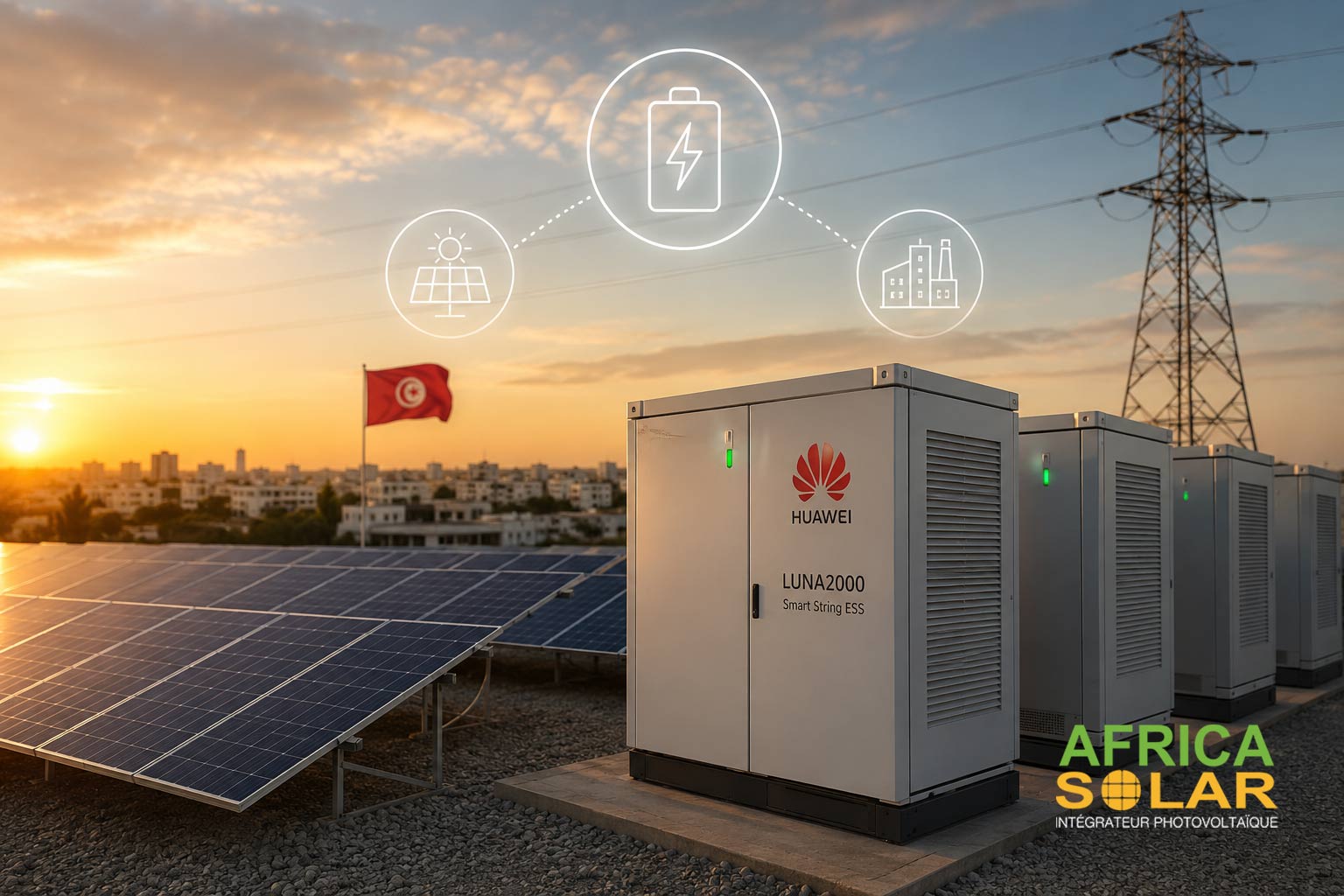
In recent days, the heatwave sweeping across Tunisia has highlighted a growing reality: the national power grid is reaching its limits whenever electricity demand surges. Air conditioners running at full capacity, record-breaking consumption peaks, and, as a consequence, widespread power outages affecting both households and businesses. While a homeowner may simply experience an uncomfortable evening without air conditioning, for a business, a power outage can mean halted production lines, spoiled goods, or critical servers going offline.
Over the past few years, solar photovoltaic (PV) systems have become an obvious solution to rising electricity costs and the growing demand for energy self-consumption. However, even the most efficient solar panels generate electricity only when the sun is shining. More importantly, a conventional grid-connected PV system does not necessarily continue operating during a power outage, even on a bright sunny day, unless it is paired with an energy storage solution.
This is precisely where Battery Energy Storage Systems (BESS) have become an essential component of modern solar installations.
Why Solar PV Alone Is No Longer Enough
A standard grid-connected photovoltaic installation without battery storage remains dependent on the utility grid. During a grid outage, most conventional inverters automatically shut down for safety reasons, even if solar production is at its peak.
This often comes as a surprise to businesses already equipped with solar panels. During a STEG power outage, they discover that their PV system also stops generating electricity. Without battery storage or a dedicated backup function, solar power reduces electricity costs under normal operating conditions but does not provide protection against grid interruptions.
How Energy Storage Changes the Equation
Integrating battery storage with a photovoltaic system offers several key advantages:
Business Continuity
In the event of a grid outage, batteries immediately supply power to critical loads, ensuring operational continuity. This is particularly crucial for industries such as food processing, healthcare, manufacturing, and any facility relying on sensitive equipment.
Maximized Self-Consumption
Instead of exporting surplus solar energy to the grid—often under less attractive compensation schemes—excess electricity generated during the day is stored and used later in the evening or during periods of peak electricity demand.
Greater Resilience
As heatwaves become more frequent and intense, the question is no longer whether the electrical grid will face increasing stress, but when. Energy storage significantly enhances resilience against these growing challenges.
Huawei's Role in the Energy Storage Ecosystem
At Africa Solar, we work with Huawei Digital Power, whose Smart PV & BESS solutions have been specifically designed to address these challenges.
Huawei's architecture is based on a distributed design. Instead of relying on a single centralized inverter, each PV string is independently optimized, while battery storage is organized into modular battery clusters, each managed by its own Battery Management System (BMS). This architecture enables earlier fault detection, improved reliability, and enhanced overall system safety.
The entire system is monitored through FusionSolar, Huawei's intelligent digital platform, allowing remote monitoring, real-time performance analysis, and intelligent optimization of charging and discharging cycles according to consumption patterns and electricity pricing.
Why Choose Huawei LUNA Batteries?
One of Huawei's strongest differentiators is its Cell-to-Cell (C2C) Active Safety Technology, which sets a new benchmark for battery safety.
Lithium battery systems inherently carry the risk of thermal runaway, particularly under demanding operating conditions such as high ambient temperatures or harsh environments. Safety therefore becomes one of the most critical criteria when selecting an energy storage solution.
Huawei addresses this challenge through its C2C technology, which continuously monitors and protects every individual battery cell, significantly reducing the risk of fault propagation in the event of an incident.
This technology has earned TÜV Prime Certification, the industry's highest safety certification for energy storage systems, providing one of the highest levels of protection currently available on the market.
What About the Cost?
Let's be realistic: battery storage represents a significant investment and is often the most expensive component of a complete solar installation.
However, this investment should be evaluated against several long-term benefits:
- The actual financial impact of a power outage, including production losses, damaged goods, and reputational risks.
- The significantly longer lifespan of today's battery technologies.
- Flexible financing models, including Build-Own-Operate (BOO) solutions that spread investment costs without requiring substantial upfront capital.
- The continuous decline in battery manufacturing costs as global adoption accelerates.
In other words, while battery storage may not yet be the most economical solution for every business, it becomes a strategic investment for organizations whose operations cannot tolerate power interruptions.
A Strategic Question for the Future
The recent heatwaves and grid constraints experienced in Tunisia are unlikely to be isolated events. As extreme temperatures become more frequent and national electricity demand continues to rise, battery energy storage will gradually evolve from a premium option into a strategic necessity for businesses.
At Africa Solar, we help organizations assess whether energy storage is technically and economically justified based on their operational requirements, consumption profile, and business objectives. Our goal is to design reliable, intelligent, and future-ready energy solutions that ensure both energy independence and operational resilience.